


No single product handles an electrical bid from the first drawing to the purchase order equally well. Most are strong at one stage and thinner at the rest, which is why a search for electrical takeoff and estimating software returns tools that barely overlap. This guide sorts seven of them by the stage they were built for.
What stages does a bid pass through?
- Takeoff. Devices are counted, circuits grouped, and wire and conduit measured from the drawings.
- Pricing. Quantities meet a material database, labor units and assemblies.
- Review. The estimate is checked against specifications, addenda and code before it goes out.
- Procurement. Equipment and gear become a bill of materials someone can order from.
Each stage has a different input and a different output, and that’s the simplest way to tell these tools apart. A product that looks weak on a feature checklist is often just built for a different step than the one being scored.
Seven tools at a glance
The table lists what each tool reads and what it hands back. Those two columns matter more than the marketing category, because they show where a product fits in the workflow you already have.
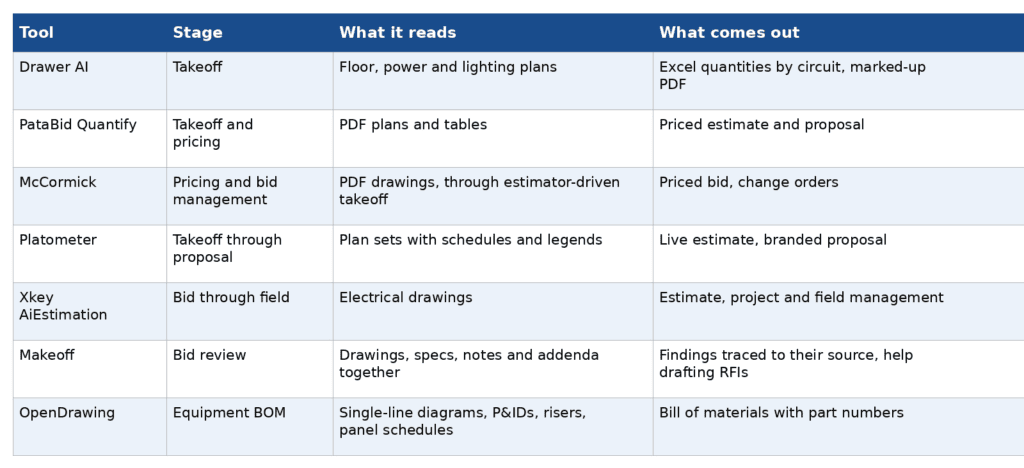
Most of the overlap sits at takeoff. Four of these tools run AI takeoff and McCormick has its own digital takeoff, but they stop at different points. Some hand off quantities, while others carry on into pricing, proposals or the field. Makeoff and OpenDrawing sit before or after the rest. So the practical question is usually which combination covers your gaps, not which single product wins.
What is each group good at?
Takeoff depth: Drawer AI. It detects devices from the drawing’s own legend, then calculates wire sizing, voltage drop and derating as part of routing. Fire alarm, security and communications devices are detected in the same pass, although automated routing covers power and lighting only. In Drawer AI’s Starr Electric case study, symbol takeoff and QA on an eight-floor, 300,000-square-foot cancer center took about 5.5 hours, against about 23 by the traditional method.
Pricing engines: McCormick and PataBid Quantify. McCormick brings 55,000+ items, 25,000+ assemblies and NECA labor units. PataBid adds live supplier pricing and a comparison of estimates against actual costs.
All-in-one platforms: Platometer and Xkey AiEstimation. Both run AI takeoff and keep going. Platometer ends at a branded proposal, while Xkey continues into project management and field operations.
Review layer: Makeoff. It reads the drawings, specs and addenda together and flags buried scope, contradictions between them and code gaps, tracing each finding back to its source. The vendor reports issues in 44% of the takeoffs it has analyzed.
Procurement data: OpenDrawing. It turns single-line diagrams, risers and panel schedules into an ERP-ready bill of materials. Floor-plan device counting is outside its scope.
The groups are less rivals than neighbors. A contractor can count and route in Drawer AI, price in McCormick and still want a review pass before submission. Vendor-reported figures, including both case-study numbers above, are worth treating as directional until you test them on your own work.
How do you build a stack that fits?
Start with the stage that costs the most hours today, and buy for that one first. Firms with a pricing database built up over years tend to add a takeoff tool in front of it and leave the rest alone. Firms with no estimating system may be better off with a single platform, trading some takeoff depth for fewer handoffs. Whichever route you take, ask every vendor for the same thing. Run a trial on a drawing set you’ve already bid, so you can check the output against numbers you trust.