
By Dave Barnes
11 Keys to Successfully Stain Exotic Hardwood for Outdoor Applications
Years ago it seemed like every wood deck was constructed from wood treated good old CCA—copper chromium arsenic—commonly referred to as pressure-treated lumber. Because most of the decks were constructed from the same type of lumber, the products and methods used to stain them were all pretty similar. But not today. Things have changed.
Over the past several years lumber yards have worked to carve their own niches in the marketplace by introducing new species of woods to the market. Such products include Cypress and Mahogany, as well as rainforest hardwoods such as Ipe and Pau-Lope. These products offer an unequaled level of beauty and uniqueness, as well as hardness and durability that far exceeds that of conventional lumber. These characteristics can offer huge advantages to the homeowner. However, they also present a variety of challenges when it comes to staining.
Typically, these types of woods are very dense, making it difficult for stains to be absorbed. Additionally, they can contain a high amount of natural oils, making them resistant to penetration. For these reasons they should be treated a little differently when staining. In this article I’ve outlined a few basics for you; “11 Keys,” as I like to refer to them, that will ensure your project looks like it was stained by a pro.
Let the Wood Weather
As I mentioned earlier, exotic hardwoods are dense and they can contain a large amount of natural oil that will work to block any wood stain from penetrating. So, let Mother Nature help you out. Once your deck has been built, allow nature’s elements to help break down the surface of the wood and dry it out so that stains will be more easily absorbed. The sun, the wind and the rain can do wonders. The more the wood weathers, the easier it will be to stain and the longer your staining job should last.
Start with a Stripper
Even if your wood is brand new and has never been stained, it is still a great idea to start your project by applying a high-quality stain stripper. I recommend Defy Exterior Wood Stain Stripper. Stain strippers are formulated using sodium hydroxide. Sodium hydroxide is an aggressive chemical that can be very effective at breaking down the surface of the wood, opening its pores and making it more absorbent. Remember, the more stain the wood absorbs, the longer your project will last.
Don’t Forget to Brighten
Yes, you have to brighten the deck too, even if you’re working with brand new wood. I know it seems kind of funny, having to brighten new wood, but the brightener will do a couple of things for you. First, it will neutralize the effects of the stripper that you used previously. You should always use an acid brightener after using an alkaline stripper. Second, in a similar fashion to the stripper, the brightener will help to open the porosity of the wood even further. Again, the more stain the wood absorbs, the better.
Take a Good, Long Break
Good news: You can take the rest of the day off. Take two if you like. The important thing is to allow the wood to dry out from all of the cleaning. The drier the wood gets, the better it will absorb the stain. So take some time off and let things dry before you start applying the stain.
Not Any Old Stain will Work
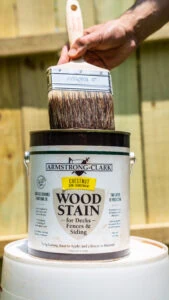
Your next big decision is what stain to use. Not just any stain will do. Certain stains have been formulated for better penetration, making them ideal for hardwoods. Many manufacturers offer a specific product in this category, such as Defy Deck Stain for Hardwoods, which is extremely durable, water-based and eco-friendly. It’s easy to use and easy on the environment. Whatever stain you select, make sure that you choose one that has been specifically formulated for use on exotic hardwoods and other difficult-to-penetrate lumber.
Ask for Directions
For the female reader, I’m confident that you’ll get this next step correct. However, all you men out there should refer to the directions. Everything that you need to know about the product you are going to use is on the back of the can. Take a few minutes before you begin and read it. The directions will make you aware of any particulars to the product that can affect how the job turns out. What is the drying time? How many coats should you apply? How much time between coats? Is there a critical recoat time? There can be any number of things that you can pick up by reading the back of the can. Take a minute to educate yourself.
Brushing is Critical
These next few keys are very important for proper application. First, regardless of how you apply the stain (e.g., rolling, spraying), it absolutely must then be brushed. If you roll it on first, simply back brush it into the wood grain while it is still wet. The same goes for spraying. “Why must I go through all that trouble?” you may ask. When you brush the stain, the brush creates a friction on the surface, breaking the surface tension of the wood and working the stain into the pores of the wood. This extra step achieves much better penetration of the stain. The more stain the wood absorbs, the longer the finished project will last before requiring maintenance coats in the future.
Wipe Off any Excess
Okay, this one might throw you a little, but again, it’s important. If you apply too much stain to the wood (more stain than the wood can absorb), then wipe off the excess. Just as you wipe off excess stain on interior wood, my advice is to do the same if you over-apply stain on exterior hardwoods. The reason is simple. First, for aesthetics; when you apply too much stain, it puddles on the surface and looks bad because of the uneven tone. Second, over time those spots are likely to flake and peel. Apply only as much stain as the wood can easily absorb.
Let it Cure
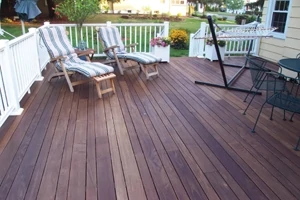
At this point the deck is done. If you’ve taken your time and followed these steps, you’ve got a great looking project. Don’t mess up now—let things dry. Leave the furniture in the yard and the dog in the house while the stain has a chance to cure. Come back tomorrow and put things back together. You’ll be glad that you waited when the stain has cured to a durable finish.
Manage your Expectations
Now, here’s some advice that I hope you accept: Manage your expectations. Remember, you’ve selected an exotic wood for your deck, a beautiful grade of lumber with extreme durability. Regardless of how good a job you did in every step of this process, you will never get the stain to last as long as it would on a more porous species of wood, such as pressure-treated pine. But also realize that every time you stain it, you’ll get a little more life out of your project. Time will continue to help the wood become more porous and as it does, it will absorb stain better each time.
Keep an Eye on Things
Last, you’ve put in a great deal of time and energy to stain your deck the right way, so keep an eye on things. As time goes on and the stain begins to fade and wear down, apply a maintenance coat. Don’t let things erode so far that you’re forced to strip everything off and start all over. It’s pretty easy and doesn’t take much time to simply rinse things off and apply a fresh coat of stain.
So that’s it—eleven keys to successfully staining exotic hardwoods. Go ahead and try these steps for yourself. See what the results are when you set out on your next project to do it like a pro. You might just surprise yourself.