


Based on a weak economy and escalating energy costs, selecting household appliances such as water heaters can be a balancing act. On one hand, homeowners want comfort and performance, and on the other, they want cost-saving efficiency. A recent survey sponsored by the Propane Education & Research Council reports that almost 60 percent of homeowners say they are likely in the next year or two to invest in new home improvements that would help save energy over time. Among the most revolutionary hot water appliances available are tankless water heaters, which are more energy-efficient than conventional tank heaters since there is no need to maintain heated water. So here’s a look at what’s new in the world of water heaters and how to take advantage of the new Federal U.S. tax credit.
Tankless Heaters
Over the past few years, a popular topic among home-improvement enthusiasts is the advent of tankless water heaters manufactured by companies such as Rheem, Takagi, Rinnai, Noritz, Bosch and Stiebel Eltron. Unlike tank-style heaters, tankless gas water heaters are more energy-efficient than conventional because they eliminate the need to continually heat a large supply of water. Also called on-demand water heaters, water enters the gas or electric tankless water heater only when the hot water valve is opened, which then triggers the heating coils or heat exchanger. The amount of energy consumed is proportional to the volume of hot water used. This energy-saving advantage is what makes tankless units today’s most popular “green” hot water solution. Furthermore, no matter how many showerheads, and no matter how deep the whirlpool, homeowners will not run out of hot water if using a properly sized tankless water heater.
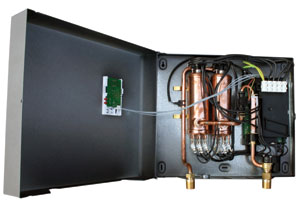
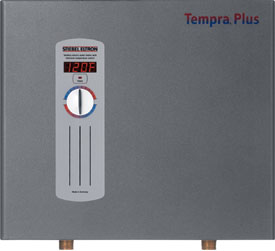
The Tempra Plus tankless water heaters from Stiebel Eltron have a digital display for fahrenheit or celsius readout and Advanced Flow Control to automatically adjust flow rate to maintain set point temperature. the Tempra series is also an ideal backup for solar thermal systems. (Photos courtesy Stiebel Eltron)
The compact size of a tankless unit is another benefit. The bulk of the traditional tank-style units comes from the tank itself; so no tank, no bulk. About the size of a medicine cabinet, tankless water heaters can easily be wall-mounted indoors or outdoors, depending on the climate. This affords the ability to place a tankless water heater closer to the point of use, which solves the problem of a long wait for hot water.
Plus, tankless water heaters afford homeowners more control over water temperature. For example, the Tempra tankless electric water heaters from Stiebel Eltron feature the latest advanced microprocessor control that allows the exact water temperature to be set via a dial on the front cover, including a digital display for Fahrenheit or Celsius. With output up to 140 degrees, this new technology ensures the water temperature will not deviate from the set point.
As far as installation, new construction is a breeze with tankless water heaters, and installation costs are comparable to those of a tank-type unit. But replacing a tank water heater in an existing home with an indoor tankless water heater takes a few extra steps, depending on the water heater’s location and the piping layout. Because tankless heaters use more powerful burners than their tank-style counterparts, they require larger gas lines. And, indoor tankless water heaters must be vented vertically (through the roof) or horizontally (through the walls). Tankless water heaters have a higher installation cost than tank water heaters, but lower operating costs, less waste and superior hot water delivery. Get a few different quotes for labor, because the installation cost can vary dramatically from contractor to contractor, due in large part to the different approaches they may take when deciding where to locate the heating unit.
Tank Technology
A household standard for many years, tank-style water heaters provide a large volume of dependable hot water. Fuel sources include propane, natural gas or electricity, and these units are the most common way to heat water in the United States. A typical residential tank water heater stores between 20 and 80 gallons, heating the water 24/7, usually at the factory setting of 120 degrees F. However, there is only so much room in the water tank, so if demand is high or the unit isn’t sized correctly, the hot water can run out. The large size of a tank unit is another aspect to consider. Because of their bulk, tank water heaters are typically located in the garage or basement, but this can put the hot water source far from the point of use. When homeowners complain that it takes too long for the hot water to reach the bathroom, this is usually the reason.
Like any major appliance, the tank heaters should be carefully matched to the demands of the house. According to industry experts, upgrading a standard 5-by-9-foot bathroom to a master suite or an in-home spa may require upgrading to a larger unit, especially if the new bathroom will include high-capacity furnishings like a deep soaking tub with a multi-head shower system. However, if this is the case, replacing a tank water heater with another tank water heater is fast and keeps labor costs to a minimum. If a remodeling budget is tight, tank water heaters are the most affordable choice, because of the minimal labor required. The cost of professional installation is typically between $500 and $1,000.
It should be reiterated that traditional tank units heat water even when it’s not in use. Insulation between the storage tank and the outer jacket reduces the heat loss, but cannot entirely eliminate it. To maintain a preset water temperature, the water heater must use energy to cycle on periodically, even when there is no demand for hot water.
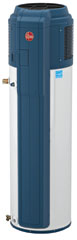
Rheem has introduced the first fully integrated Heat Pump Water Heater. With an energy Factor(EF) of only 2.0, the new air-source heat pump water heater offers more than twice the energy efficiency of a standard electric storage water heater. (Photo courtesy Rheem)
However, Rheem has recently introduced a groundbreaking advancement in tank heater technology—a fully integrated Heat Pump Water Heater. With an Energy Factor (EF) of only 2.0, the new air-source heat pump water heater offers more than twice the energy efficiency of a standard electric storage water heater. Instead of heating stored water directly with a conventional electric element—or with a burner, as in the case of a gas unit—a heat pump water heater transfers available heat from the ambient air, intensifies the heat and transfers the heat into the water, which is a far more cost- and energy-efficient process. Intended for residential applications, both new construction and drop-in replacement of existing water heaters, the unit has a storage capacity of 50 gallons and qualifies for an Energy Star listing and the federal tax credit. Plus, by measuring only 21 inches in diameter and 75-1/2 inches tall, the new unit offers a slimmer, more portable profile that makes it easy to install in spaces with restricted access.
The concept is already catching on as Stiebel Eltron has just released its own heat pump water heater, the Accelera 300.
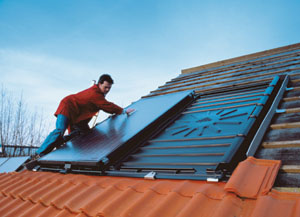
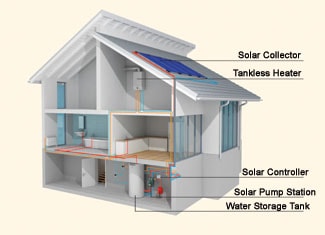
Solar collectors can heat water in the household an dprovide additional support for the central heating system. (Photo courtesy Bosch Gmbh)
Solar Heated Water
Solar water heaters use a dark-color solar collector to capture free energy from the sun, making it the most environmentally friendly home water heating option available. These solar systems can be “passive,” meaning the water flows between the collection area to the storage tank via gravity or some other non-mechanical means; or “active,” which uses a pump to circulate water through the system. The passive systems have both the tank and collector located on the roof, taking full advantage of the direct sunlight. However, some roofs aren’t designed to support the weight of the water tank (and some homeowner associations may frown on a roof-mounted tank), so an active system is the alternative. The active systems have the tank and pump located in the house or garage, although the pump that forces circulation does require more energy than passive systems.
Even the most efficient solar water heaters usually require some auxiliary heating to boost the performance. This may be because of a high water demand in the evening or after a long period of cloud cover. An electric, gas or other fuel-type booster can be quite effective in enabling a solar water heater to provide a year-round supply of steaming hot water, but of course that also boosts energy demands.
Tax Credit for Energy-efficient Upgrades
In February of 2009, President Obama made significant changes to the homeowner tax credits for specified energy-efficient home improvements. These improvements include qualified heating and cooling products, such as tankless and solar water heaters. These revisions include an extension of the tax credit through 2010. Homeowners who purchase a qualified heating and cooling product before December 31, 2010 are now eligible for a tax credit equal to 30 percent of the full purchase and installation price. There is a $1,500 cap on the credit per home. (Some improvements, such as solar water heaters, may not be subject to the $1,500 maximum.)
For more information on how to take advantage of the tax credit, visit the IRS website at www.irs.gov.
Boiling it Down
As you can see, there are pros and cons to each type of water-heating system. The more efficient tankless systems have a greater upfront cost, but can pay off in energy savings and performance down the line. A replacement tank heater is less costly to install but requires more energy usage. And even the greenest of options—solar heating— requires some cooperation from Mother Nature to wring the most energy efficiency and performance from the system. So the next time you’re selecting a system, carefully weigh your initial installation budget against your long-term utility costs. And always keep up on the latest technology, because water heating is an ever-evolving industry.