
By Matt Weber
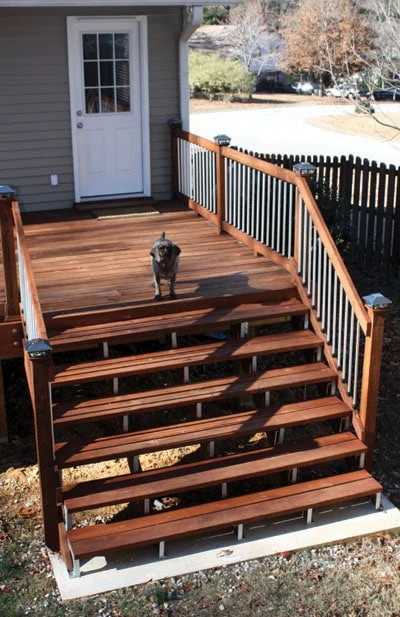
I spent most of last spring building a big deck, so I wanted a big set of stairs to match. A width between seven to eight feet seemed like ample space for walking and be large enough to give the nearly 40-foot deck a visually complementary stair design. I had left the deck handrail unfinished at the stair location, which provided the upper landing, but I had to construct the lower landing on the ground from concrete, as well as everything in between. Here’s a step-by-step account of the job, from digging the slab to staining the handrail.
Start with a Plan
Laying out the staircase is the first step. The pitch of your stairs will be determined by the rise and run you need to traverse to reach the landing, factored with a comfortable tread and riser height that adheres to local building codes. (For example, maximum riser height is typically 7-3/4 inches; minimum tread depth is usually 9 inches.) Stair layout can be a complicated process, so for an in-depth look at calculating stairs, click here. Because, for this project, I cheated.
I designed these stairs for the Universal Stair Brackets from GoPro Construction. Made from 16-gauge hot-dipped galvanized steel, these brackets eliminate the need to cut stair notches, and reduce measuring and marking as you screw in the pre-marked stair hangers. It saves a lot of work. Plus, when I say that I “cheated” during the layout phase, I was referring to the Stair Calculator available at decks.com. Simply type in your total rise and run, and the stair calculator spits out the number of risers and runs (brackets) needed, as well as stringer length, slope and tread height. Plus, with the click of a mouse you can adjust the stair slope to make it more or less steep, and the layout figures are automatically adjusted for you. I was happy to cheat.
One note about slope: Depending on the proposed handrail system of your steps, you may be limited in the range of slope you can use. For example, I was using the Deckorators handrail system with specific stair connectors that will only work on a slope of 30 to 35 degrees. You’ll need to account for such requirements when designing the stair layout.
The width of my staircase was another unusual factor. Code typically requires the stairs be supported by stringers spaced no greater than 2 feet on center, which meant my unusually wide staircase required a total of five stringers.
Concrete Construction
With my measurements provided by the GoPro calculator, I could then map out where my lower landing would be on the ground. Building a slab landing can be tough work, requiring a lot of digging and other sorts of manual labor. Be prepared for a workout if you’re tackling this job.
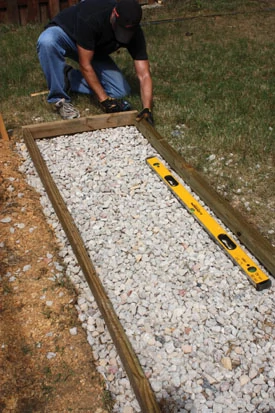
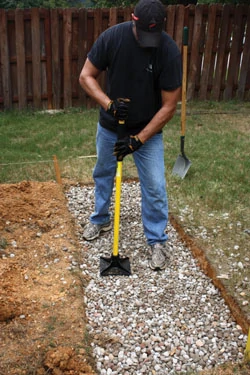
First, mark the perimeter of the slab with stakes and string. Make sure it is deep enough to completely support the mitered bottom of your stair stringers. Then, calculate the depth of the finished slab, including concrete and gravel base, and excavate the soil necessary to place the finished surface of the concrete about an inch above the ground.
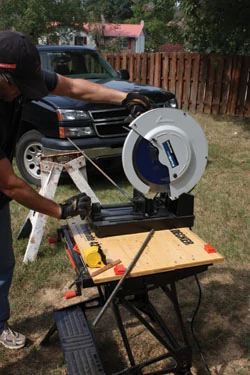
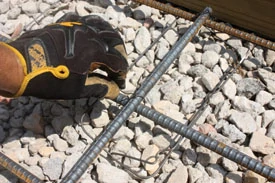
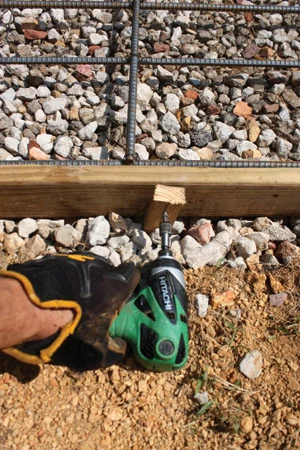
The first layer of my slab consisted of 5 inches of gravel compacted down to 4 inches with a hand tamper. Next, I laid a grid of rebar on wire brackets that float the rebar about midway deep in the concrete forms. I tied the rebar intersections with wire. Then, I screwed together the rectangular concrete form from 2-by-4s. I leveled the form on the gravel bed and staked it in place every 18 inches from the outside of the frame.
There was a slight grade in the soil I had to overcome to ensure that my stair landing was built level. To accommodate the slope I partially buried one end of the form below grade, with just the top inch of the form above ground to shed water. The opposite end was set above grade, with the edge of the form exposed. These two alterations allowed me to level it from left to right and front to back, and stake it securely. Be sure the form is flat to achieve an even landing for the stair stringers.
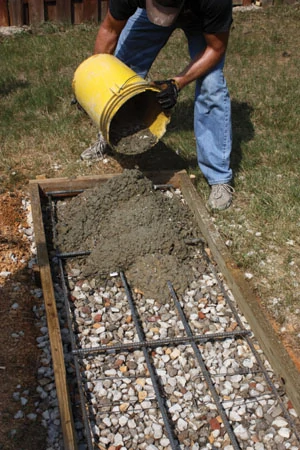
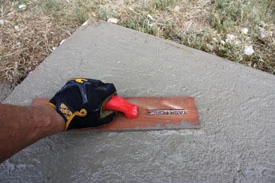
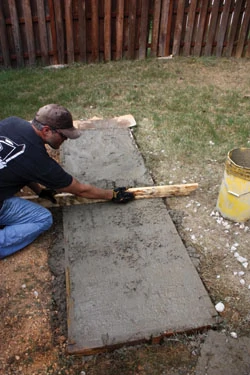
I mixed up some quick-drying concrete, one bucket at a time, and filled my form. It took longer than expected and next time I’ll rent a concrete mixer. You should spray down the form and the gravel with water when adding the concrete. Keep the entire work area damp throughout the installation of the concrete. When it reached the top of the forms, I struck off the excess concrete even with the top of the forms by screeding it with a very straight 2-by-4. I then used a wood float to work the heavy aggregate below the concrete surface and bring the “cream” to the top. Allow the concrete to cure for a few days. Because I was building during the heat of summer, I kept the slab covered in plastic to retain moisture for a slow, solid cure.
Stringer Solution
While the concrete dries, you can cut the stringers. Traditional stair-building methods require cutting notches in 2-by-12’s to support the stair treads. Laying out the correct measurements can be difficult, and the cutting process can be very time-consuming. However, by using the metal stair brackets, I only had to determine the length of the stringers and the angle of the end cuts. Also, the stringers can be made from 2-by-6’s rather than 2-by-12’s. Making things even easier, I already had the run and the slope of the stairs provided for me by the GoPro calculator.
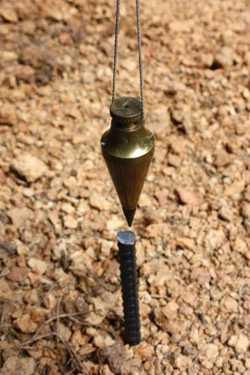
First, I dropped a plumb line from the edge of the deck, and marked the point with a peg of rebar. I then measured the total run straight from the plumb mark to the concrete landing, and marked where to locate the end of the stringer.
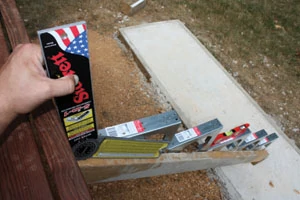
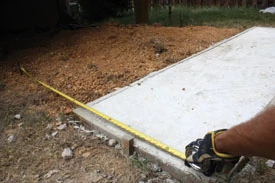
Then, being a very visually oriented person, I determined the stringer layout by tacking up a temporary 2-by-4 stringer (mitered at the upper end) to the rim joist of the deck. I adjusted its angle until I was satisfied that a 2-by-6 replacement would land solidly on the concrete landing (and ensuring the slope was within the parameters of my handrail system). I staked the end of the temporary stringer in place and registered the angles with my Starrett Pro Site Protractor.
Note: If your method of anchoring the stringers is to notch the upper ends to accept the deck’s rim joist (as I did), then remember that the bottom end of the stringer will be pushed back the same distance as the depth of your notch. Account for the notch when measuring the stringers.
Using the temporary stringer is a personal preference that helps me to “see” the design before I build it. In fact, I temporarily tacked on some stair brackets to get a visual grasp of how the system would come together.
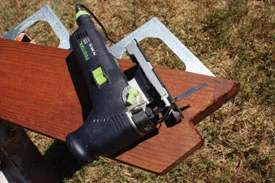
I made the miter cuts on the 2-by-6 stringers with a sliding miter saw and notched their upper ends with a jigsaw. I also pre-stained and sealed the stringers.
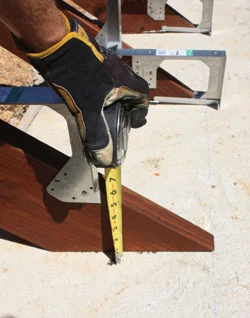
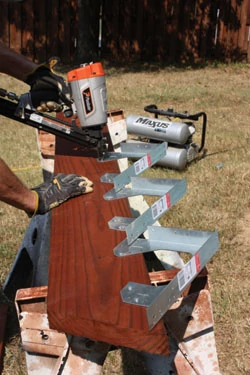
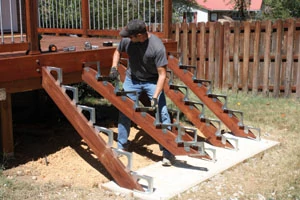
Installation of the stair brackets is a simple procedure because they include marked measurements along both the rise and run of the bracket. I was working with a 7-1/4-inch rise (step height) and a 10-inch tread depth (run), so I aligned the L-shaped stair brackets along the corresponding markings, tacked them to the stringers with nails, then cinched them down with screws. I used four 1-1/2-inch No. 8 cone-head exterior screws in the predrilled holes of each bracket.
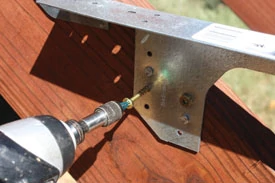
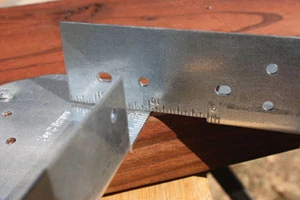
At the end of each stringer, the final bracket had to be cut to fit. I marked a parallel line on the bracket where the stringer would meet the landing, subtracting 1/8 inch for the base stringer bracket. I chopped the bracket to size on a cutoff saw, screwed it to the stringer and added the galvanized base stringer bracket, which screws to the stringer from the bottom.
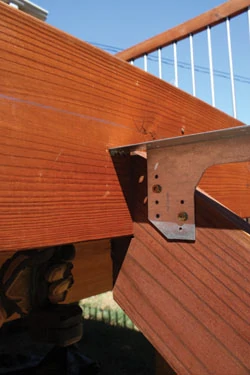
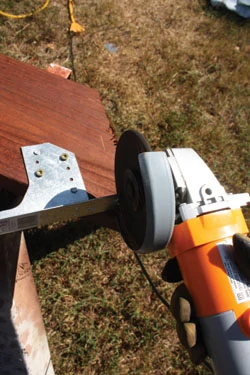
I marked each of the five stringer’s on-center locations along the deck rim joist and fastened them in place with 3-inch exterior deck screws driven through the joist and into the mounting notches. My stringer notches were each about 1-1/2 inch deep.
At the bottom end of the stringers I used a hammer-drill to drive Tapcon screws—two per stringer—through the predrilled base brackets and into the concrete landing.
Treads
To install the stair treads I simply measured from outside bracket to outside bracket, cutting the treads to fit. For my 11-inch treads I combined two 2-by-6’s. Combining two boards to create a tread is preferable to using a single board because the combination is less likely to cup or warp.
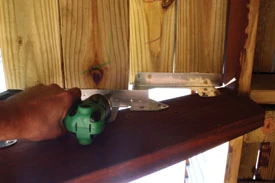
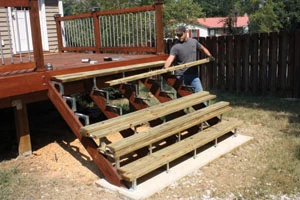
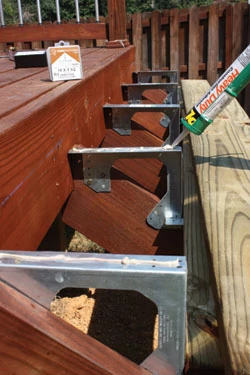
To prevent squeaking I ran a bead of poly construction adhesive along the edge of each metal bracket before installing the treads. I fastened the treads from below through the predrilled bracket holes using 1-1/2-inch R4 screws from GRK Fasteners. These tough fasteners have enough bite to pull the boards flat to the brackets.
Handrail
The handrail system for my deck stairs originated with two deck posts that framed the stair opening. I installed two matching lower posts to the outside stringers with a couple of 1/2-inch galvanized through-bolts and washers for each.
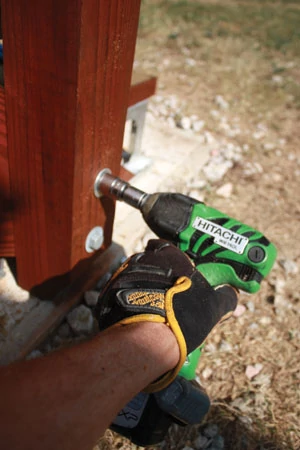
I prestained the posts and rails, and installed the handrails flush between the posts with Deckorators stair brackets, basing my miter cuts on the slope of the stair stringers to keep all the components parallel.
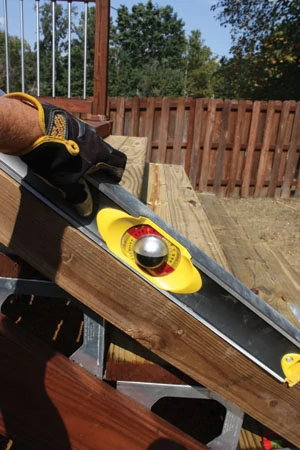
I matched the slope of the handrail system to the slope of the stringers.I was incorporating stainless aluminum balusters that install over the lower rail, with the upper rail capping the balusters. Each of the balusters is fastened to the rails using a special connector piece, which is why I had to keep the slope of the stairs between 30 and 35 degrees.
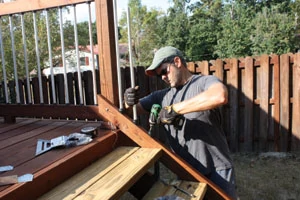
As a finishing touch, I topped the deck posts with Deckorators Solar Post Caps from Maine Ornamental. These accessory post caps simply glue to the posts. They require no wiring and recharge daily to automatically produce ambient night lighting for the deck and staircase.
For a more detailed look at installing the Deckorators railing system and post caps, visit www.extremehowto.com and www.deckorators.com.