
Special Advertorial Section
Concrete is gaining in popularity as a building material for driveways. According to the National Association of Home Builders, 68% of new homes in 2006 had a concrete driveway installed. That is an increase from 60% in 2001. Concrete is a durable material that will give years of life. While it is basically man made rock, it will not last forever on its own. Water and especially de-icing salts that are used in cold climates are able to damage driveways. Accurate records are not kept, but it is safe to assume that the vast majority of new driveways are not sealed from water penetration. A good concrete water repellent is needed to ensure your driveway is protected.
Types of Concrete Driveways
Concrete is a time honored way to make a driveway that lasts a long time. Decorative concrete that has been colored and textured to look like another material is gaining in popularity. However, most driveways and what this article will deal with is plain concrete that has a trowel or broom finish to it. These driveways are white to grey in color.
Damage from Water
Concrete is a porous material that naturally absorbs water. Any rain water will soak into the concrete and can cause spilling, pitting, or flaking. This is especially true for cold climates that experience a freeze and thaw cycle. Water gets into the concrete and then expands when it freezes. This expansion physically damages the concrete. Its most noticeable damage is the flaking of the top layer of concrete, which exposes the aggregate below.
Damage from De-icing Salt
An even larger danger is the chemical damage that occurs from de-icing salt use. The salt ions are carried by the melted ice water into the concrete. Inside the concrete the salt attacks not only the concrete itself, but also the steel reinforcing that is in the concrete. This steel will quickly rust from the salt and lose its bond to the concrete. Once the bond is lost between the steel and concrete, the concrete is weakened and may experience a more pronounced amount of cracking.
Stop the Water Absorption
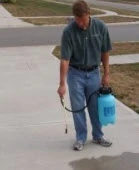
Penetrating water repellents made of silane/siloxane can stop the water absorption. This material soaks into the concrete and then reacts with the free lime content to form a water resistant barrier. This barrier is invisible. It is not on the surface of the concrete where it would erode away from car and foot traffic. The water repellent is actually below the surface of the concrete. The traction of the driveway remains the same so you will not slip. The color stays the same. And there is no glossy sheen to the driveway. The driveway maintains its natural look.
Since the water cannot get into the concrete, de-icing salts also cannot get in. So a concrete driveway that is protected with a silane/siloxane blend is protected from both water and de-icing salts.
Silane/Siloxane Water Repellents
As noted, a water repellent made of silane or siloxane is a great way to protect your driveway. Sunlight can’t turn them yellow since they are below the surface. There is no flaking since they do not form a film on the surface of the driveway. Most importantly, they are breathable. So any moisture that is in the concrete from being in contact with the ground is able to get out.
This article is written by Aaron Kuertz with Applied Technologies. Aaron has been in the waterproofing industry since 1998. Applied Technologies is a manufacturer and supplier to professional waterproofing contractors and homeowners in the United States.
For more information about concrete water repellents, contact Applied Technologies.