
Concrete offers an inexpensive alternative to traditional flooring materials.
Not too long ago, the only acceptable place for concrete floors was a warehouse. Today, concrete has become a stylish alternative material for floors, countertops, patios, driveways and walkways. Finished concrete, such as stamped or stenciled concrete, can be scored in a variety of geometric patterns, and they can be dyed almost any color or combination of colors.
Decorative concrete is a broad term used to describe the process of taking concrete while in its liquid phase and adding color and texture to the surface to make it appear more natural. Contractors began experimenting with decorative or finished concrete on the West Coast in the early ’60s. The first stamping tools were metal shapes that were rammed onto the surface of the concrete to form a pattern. During the last several decades, the equipment has evolved into rigid mats made of polyurethane that not only stamp geometric shapes; they can also mimic the look of stone or wood.
With finished concrete, your options are almost limitless. Concrete overlays are less time- and labor-intensive than many flooring materials and can totally transform the surface to which they are applied. Overlays are a good choice for interior or exterior projects. Stamped concrete is great for patios and outdoor areas; a pattern is imprinted into the surface to mimic the look of more traditional or natural materials such as brick or flagstone. Finally, stenciled concrete uses a heavy paper stencil to create a uniform pattern.
Concrete Overlays
Concrete overlays can create an entirely new look and provide a smooth surface. They can also be an inexpensive solution if you do not have to tear out an existing slab. Most overlays combine cement with a variety of aggregates and polymer resins. The resins add flexibility and compression strength to combat cracking, freeze damage, discoloration due to water damage and scuff marks. Many manufacturers such as Elite Crete, Increte Systems, Bomanite, Artcrete and Concrete Solutions provide formulas with sand, cement, pigment and additives. With these types of mixes, water is the only other needed material. Other mixes may require both a pigment and polymer additive. If you choose to mix your own concrete solution, pay special attention to the recommended ratios. When mixed correctly, good overlays can be spread as thin as a 1/32-inch skim coat.
Prepare the surface to be overlayed by removing oil, wax, grease, paint, latex compounds, sealing compounds and any other contaminate that could affect the final bond between the substrate and concrete overlay. Some manufacturers recommend scoring or acid-etching to prepare the concrete surface. Surface irregularities must be repaired prior to the application of coatings. A surface with lots of damage can show through the overlay. In most cases, toppings can fill and repair surface irregularities up to twice the thickness of the topping material.
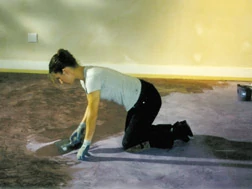
Application can be a breeze if you use commercial overlay preparations; many products are self-leveling. If you mix your own, you must use a trowel. After self-leveling overlays are poured, application is complete with the touch of a smoother, spreader or porcupine roller depending on the desired thickness and texture. Many do-it-yourselfers choose to contract the self-leveling overlay and then enhance the new surface through stenciling or stamping. A thin-stained overlay is one of the more popular finish looks. After the overlay has been applied, you can use a chemical acid or water-based acrylic stain to color the surface. You can even paint the floor with the same faux-finish looks that have become so popular on walls.
Standard, gray concrete does not always require a sealer. However, decorative polymer overlays should always be sealed or coated to protect the surface and make maintenance easier. Typically, sealers consist of two coats of a 20- to 25-percent solids material spread at 300 to 350 square feet per gallon. Coatings are applied more heavily than sealers and are designed to build a surface film. They usually consist of two to three coats of 40- to 60-percent solids material spread at 200 to 350 square feet per gallon.
Stamped Concrete
In the past, just about the only concrete stamping was performed by kids pressing their handprints into freshly poured concrete, or an accidental leaf print in the Fall. Today, the leading finished concrete process is stamping. The process involves pressing three-dimensional patterns into colored concrete with specialized tools. The finished product combines the durability of concrete with the look of fine masonry. Common patterns mimic the look of slate, brick, granite, cobblestone, tile and flagstone. Patterns can be combined to create decorative borders and designs.
If you opt not to use a concrete mix with color added, you can add the color after the concrete has been placed and bull floated (bull floats are tools used to smooth the surface of freshly poured concrete). Color hardener should be applied to the surface area after excess bleed water has evaporated. After the hardener has been slick-finished, a powder release agent should be applied. The agent will keep the stamping tools from damaging the surface of the concrete.
It is important that the first stamp mat is laid in the true center of the concrete surface, and that it is square. Keep the mats fitted tightly together to create neat grout lines, and begin expanding the pattern from the first-laid stamp. A tamper should be used to firmly imprint the texture and pattern of the stamp into the concrete. Bands can be placed every 10 to 12 feet to break up the primary pattern and to provide a straight line to place an expansion joint. This will help hide the expansion joint from view. It will also help create a more random, realistic pattern.
After the concrete has been allowed to set several days, you can pressure-wash the excess release agent from the surface. After your new project has completely dried, two coats of a high-solids sealer can be applied to the surface using a nap roller. The sealer protects the surface from staining.
Stenciled Concrete
It is easy to be fooled by stenciled concrete. The recently developed materials and processes make it nearly impossible to differentiate a stenciled slab from actual masonry work. The stencils are made with heavy-duty professional paper and come in rolls of up to 1,000 square feet. They are cut into matrix patterns and are available in a variety of patterns. Much like the concrete overlay and stamped concrete, installation of stenciled concrete requires the paper stencil to make the pattern, a color hardener and a sealer.
After the concrete has been poured, the precut stencil is laid across the area and gingerly worked into the surface of the wet concrete. Cut the stencil to fit with scissors. Slightly embed the stencil into the surface of the concrete with a stencil roller. The number of passes you make with the stencil roller and the pressure you apply will determine the amount of relief between the “bricks” and the “mortar.” Once the surface water has evaporated, two to three coats of color hardener should be applied over the entire project area and worked into the surface with a trowel. Wait several hours before removing the stencil to reveal the pattern. If some of the color hardener accidentally leaked under the stencil, it may be chipped away by hand.
Finished concrete is a long-term, less expensive alternative to traditional masonry work. Plus, you won’t waste time pulling weeds and grass that has grown through the joints. Once sealed, the concrete will not stain and it is simple to maintain with only a quick sweep and rinse offering a striking appearance year after year.